
向幸福出发
'Decoding the Book of Xi Jinping: The Governance of China' 27th installment: Striving for greater strength and self-reliance in science and technology_我的网站

一 |

A few days ago, The New York Times published a story with the headline "China's Robots Know Kung Fu and Can Scale Walls. Can They Woo Investors?" Soon after, China's capital market delivered its answer through Unitree Robotics' IPO. Investors piled in so heavily that the preliminary online subscription multiple hit an eye-watering 8,288.82 times. The strong demand can, to some extent, be seen as a vote of confidence from investors in the commercial prospects of humanoid robots. The market's verdict is clear: China's robots have received a high score.
In recent months, China's robotics sector has drawn growing international attention. Some overseas commentators have questioned whether Chinese humanoid robots are still "performative rather than functional," casting doubt on the prospect of a large-scale commercial market emerging in the near term. The IPO of Unitree Robotics, however, has provided fresh evidence in that debate. According to the company's prospectus, its revenue rose from 159 million yuan ($23.6 million) in 2023 to 1.699 billion yuan in 2025. The numbers point to the expanding commercial potential of robotics.
For those seeking to gauge the progress of China's robotics industry, Unitree Robotics' prospectus is worth a closer look. Beyond the numbers, the document offers a detailed picture of the company's products, business model and growth strategy. Given Unitree Robotics' role as one of the sector's notable players, the prospectus also provides a useful reference point for assessing the industry's current stage of development.
Over the past few years, China's technology capabilities have expanded across a range of fields, from semiconductors and artificial intelligence to humanoid robots and beyond. This progress has given rise to a group of technology companies that are now entering a more active phase of public listings. The IPO of CXMT, for instance, attracted considerable attention. More technology companies are expected to follow. The emerging wave of technology IPOs suggests that China's capital market is accelerating its role in bringing technology companies closer to investors and the broader market.
As more Chinese technology companies enter the capital market, prospectuses, financial reports and market responses are bringing more information about their profitability and strategic direction into public view. This gives global observers more data points with which to assess China's technological development. Questions such as whether humanoid robots are merely a momentary wave of attention or a business opportunity backed by market fundamentals can increasingly be answered through financial markets. In this process, China's capital market is bringing more information into view and creating a reference point grounded in market realities for technology companies, one that exists beyond external narratives and speculation surrounding China's technological rise.
In recent years, China's technological rise has generated considerable international discussion. Within that discussion, two distorted narratives have emerged. One portrays China's technological progress as a "threat" far beyond what the evidence supports, while the other seeks to downplay its advances. The coexistence of these two opposing narratives has made it harder for the outside world to develop a more rational assessment of China's technological development.
China's technological progress does not need to be exaggerated, nor does it need to be underestimated. The capital market may be building an information base rooted in business realities, allowing investors to examine, evaluate and assign value to technology companies based on their actual performance. Such a mechanism could help address some of the questions surrounding China's technological development: How far has China's semiconductor industry advanced? Can external technology restrictions deliver their intended results? What directions will shape the next stage of growth?
As this information base rooted in business realities continues to evolve, international perceptions of China's technology sector should increasingly be grounded in facts. The West's engagement with Chinese technology companies could also be guided by market principles - making judgments based on business and economic realities rather than allowing politically driven narratives to distort assessments of technological progress.
The author is a reporter with the Global Times. [email protected]
。
Editor's Note:
Ahead of the opening of the 2026 World AI Conference and High-Level Meeting on Global AI Governance, Chinese AI start-up Moonshot AI released its Kimi K3 large language model. As the world's largest open-source model by parameter count to date, this launch marks a significant step forward in the development of China's artificial intelligence models.
From the C919 airliner soaring into the skies to Unitree's humanoid robots stealing the show; from DeepSeek pushing the AI frontier to Moonshot AI's landmark unveiling of Kimi K3 - China's wave of homegrown innovations has dominated global headlines in recent years, delivering a steady stream of breakthroughs.
At a meeting in Beijing that brought together the national science and technology award conference, the general assemblies of the members of the Chinese Academy of Sciences (CAS) and the Chinese Academy of Engineering (CAE), and the 11th national congress of the China Association for Science and Technology in July, Chinese President Xi Jinping, also general secretary of the Communist Party of China (CPC) Central Committee and chairman of the Central Military Commission, stressed that the 15th Five-Year Plan period (2026-2030) is a critical phase for tackling tough challenges in building up the country's strength in science and technology.
"We must seize the historic opportunity, rise to the challenges of the times, accelerate efforts to achieve high-level self-reliance and strength in science and technology, and make steady progress toward the 2035 goal of becoming a leading country in science and technology," he said.
In the article "Strive for Greater Strength and Self-Reliance in Science and Technology" included in the fourth volume of Xi Jinping: The Governance of China, Xi pointed out, "Through years of endeavor, our country's overall strength in science and technology has improved substantially. We therefore have a solid foundation, and are fully confident in our ability to seize the opportunities offered by the new revolution in science, technology and industry to achieve greater results." The article also mentioned that "We should participate to the full in global science and technology governance, contribute Chinese wisdom, and shape a philosophy of technology for good purposes, so that science and technology better serve human wellbeing, and enable China's science and technology industry to contribute more to building a global community of shared future."
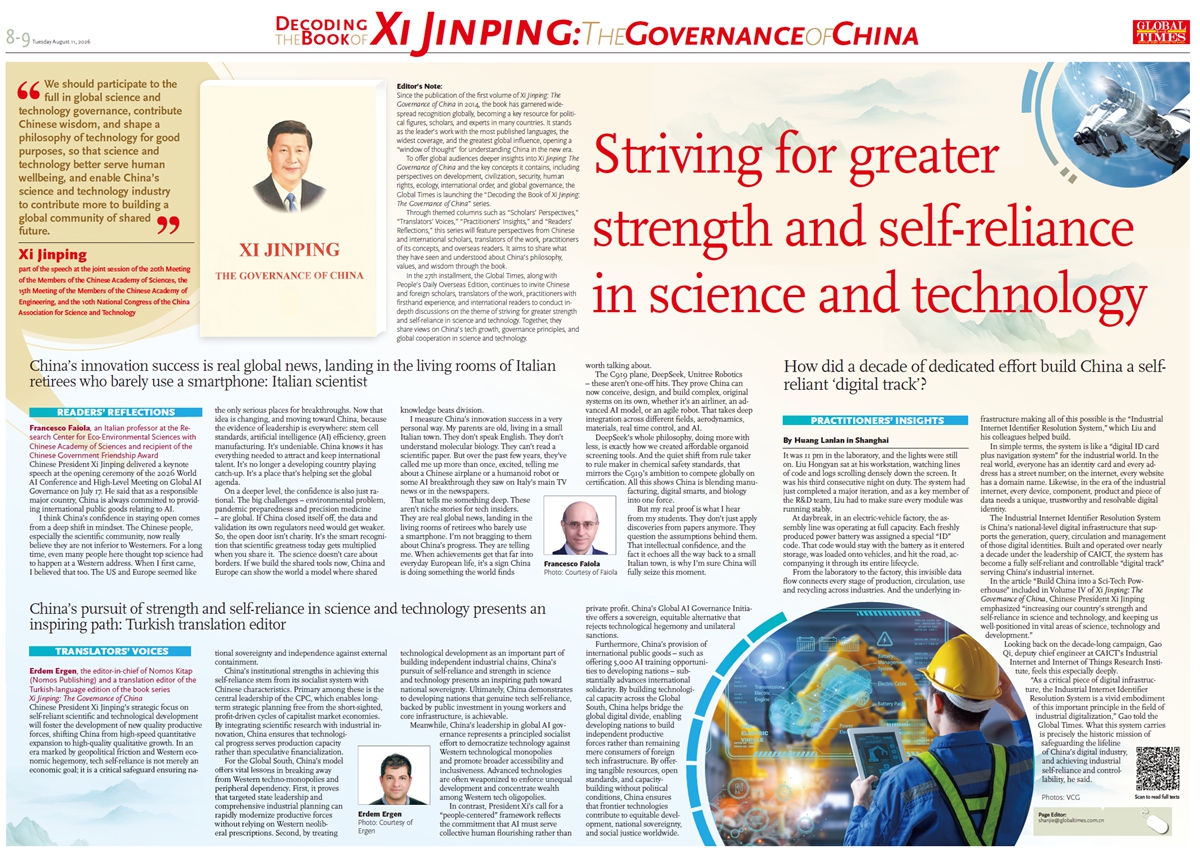
In the 27th installment of the special series "Decoding the Book Xi Jinping: The Governance of China," the Global Times, along with the People's Daily Overseas Edition, continues to invite Chinese and foreign scholars, translators of Xi's works, practitioners with firsthand experience, and international readers to focus on the theme of striving for greater strength and self-reliance in science and technology. Together, they share views on China's tech growth, governance principles, and global cooperation in science and technology.
Here are the stories:
1. Readers’ Reflections: China’s innovation success is real global news, landing in the living rooms of Italian retirees who barely use a smartphone: Italian scientist
2. Practitioners' Insights: How did a decade of dedicated effort build China a self-reliant 'digital track'?
3. Translators’ Voices: China's pursuit of strength and self-reliance in science and technology presents an inspiring path
4. Scholars’ Perspectives: National support, optimized evaluation allow young talent to pursue long-term breakthroughs: researcher
。

二 |
Current article:http://www.choumaimuwogenkuzhainuan.bond/85fx79/qdccmk9.docx
Published on:03:33:41